

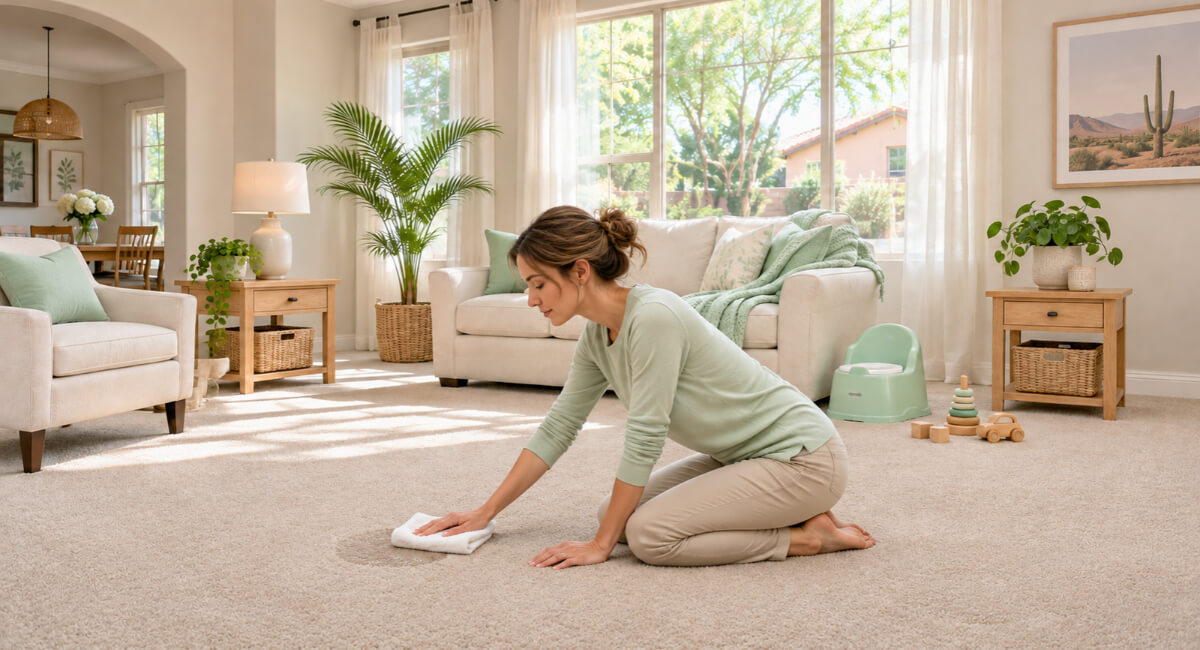
Potty training comes with wins, setbacks, and more than a few puddles on the living room carpet. Accidents are part of the process, but the stains and odors they leave behind don’t have to stay. Acting quickly and using the right technique make all the difference.
At Mint Services Company, we bring more than 30 years of carpet cleaning experience to Phoenix-area families. Our IICRC-certified technicians use pet-safe and child-safe solutions that we rinse out thoroughly, so no harmful residue stays behind where little ones crawl and play. Every job is backed by our 100% service guarantee.
Why Potty-Training Accidents Are Tough on Carpet
Urine Travels Below the Surface
Carpet fibers don’t stop a puddle. Liquid can move through the pile and backing into the carpet cushion and, in some cases, the subfloor. The Carpet and Rug Institute’s technical bulletin on pet urine and carpet notes that some manufacturers now make backings designed to resist spills and keep them from reaching the cushion.
That bulletin focuses on pets, but the same basic problem applies to any urine accident. The longer it sits, the deeper it can travel, and the harder it becomes to remove from every layer.
Stains and Odors Can Show Up Later
CRI explains that urine can affect carpet dyes, although not every accident leaves a permanent stain. Some spots show up right away, while others take weeks or months to appear. Masked odors can also return during periods of high humidity, so a spot that seemed clean may smell again later.
Left untreated, urine can also weaken the bond between carpet backing layers and cause delamination, according to CRI. That’s one more reason to treat accidents as soon as you find them.
How to Clean a Fresh Potty-Training Accident
CRI’s Spot Solver outlines a general spot removal procedure that works as a starting point for most fresh spills. Follow these steps, and check your carpet manufacturer’s care instructions before using any product.
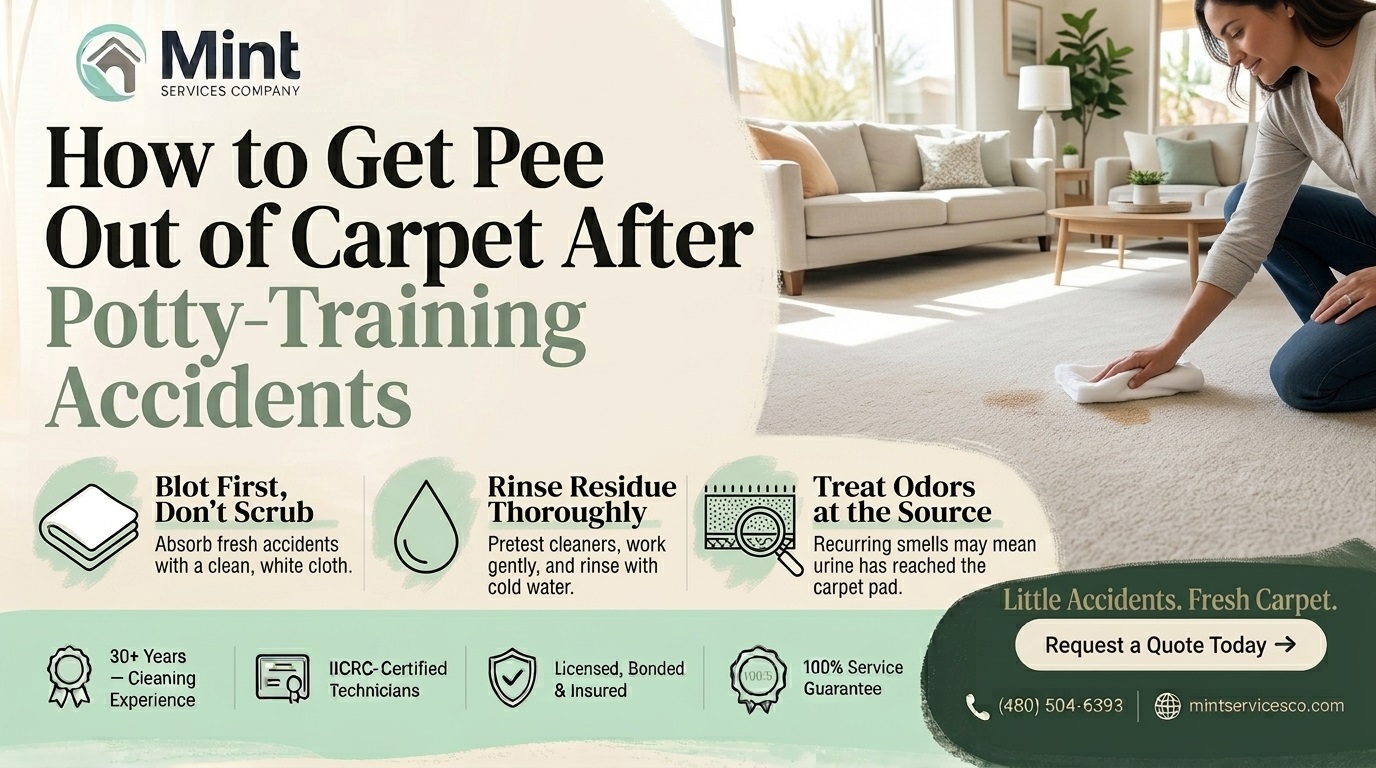
Step 1: Blot Right Away
Don’t wait. CRI warns that delaying may cause a spill to become a permanent stain. Blot the area with a dry, white absorbent cloth or white paper towels, pressing firmly to pull up as much liquid as possible. White materials keep dye from transferring onto your carpet.
If the accident wasn’t only liquid, CRI advises gently scraping up semi-solids with a rounded spoon before blotting.
Step 2: Pretest Your Cleaner
Choose a spot cleaner labeled for urine. CRI’s bulletin points readers to approved pet stain and odor removal products in its Seal of Approval program. Test the cleaner in a hidden area and blot with a white cloth. If color transfers or the carpet changes, choose a different product.
Using a spot removal kit? CRI notes that some include a stain-resist solution, and applying it before the spill is fully removed may cause a permanent stain.
Step 3: Work From the Edges Inward
Apply a small amount of cleaner to a white cloth rather than pouring it onto the carpet. CRI advises working it in gently from the edges of the spot toward the center to prevent spreading, without rubbing. Let it sit a few minutes, then blot. Repeat as long as the stain keeps transferring to the cloth.
Step 4: Rinse and Dry Completely
Once the spot is gone, CRI recommends rinsing with cold water and blotting until all moisture is removed. Many spot removers leave residues that attract soil, so rinse several times. A mist-type sprayer helps prevent overwetting, which can push urine deeper into the cushion.
How to Tell If Urine Has Reached the Carpet Pad
If your carpet still smells like urine after cleaning, the problem may sit below the visible fibers. Liquid can seep through the backing into the pad, where surface cleaning can’t reach all the affected material.
Why Surface Cleaning May Fall Short
The EPA’s guidance on carpet and indoor air quality warns that carpet that stays damp can become a primary source of microbial growth. Its mold course on finding moisture problems adds that carpet backing and padding must be dried along with the carpet itself, or mold will likely result.
These pages address moisture rather than urine, but they show why a clean surface doesn’t always mean a clean carpet.
Stronger Signs the Pad Is Involved
Some clues point more clearly below the surface. An odor that fades while the carpet is damp but returns once it dries suggests residue in the backing or pad. So does a smell that keeps coming back to the same spot after several cleanings, or one that grows stronger when you press down on the carpet.
Lingering moisture is another warning sign. If the area stays damp longer than expected or becomes damp again, stop adding cleaner, since extra moisture can travel deeper and complicate drying.
Signs That May Be Surface-Level
Not every mark means the pad is affected. A visible stain with no lingering odor may be dye damage at the fiber level, which CRI notes urine can cause. A smell that disappears after one cleaning and never returns usually points to a surface spot.
Keep in mind that the affected area can be larger than the stain you see, so check the surrounding carpet too. These signs are clues, not proof.
Safe Steps for Checking Underneath
Start with your senses. The EPA’s mold course notes that the most important equipment for finding moisture problems is your own eyes and nose. Kneel close to the spot and the area around it, then press a folded white paper towel firmly onto the carpet for a minute to check for dampness.
For a closer look, an inexpensive moisture meter can help, and the EPA lists carpet among the materials these meters can test. Compare the spot with a dry area nearby. Wear gloves, keep kids away, and don’t pull wall-to-wall carpet off its tack strips, which are sharp.
When to Call a Professional
If the smell persists, a professional inspection can show whether the backing, pad, or subfloor needs attention. The EPA notes that investigating hidden moisture problems can be difficult and may call for someone with experience. Treating the source works better than masking the odor again and again.
Keeping Little Ones Safe While You Clean
Toddlers spend much of their day on the floor, and the EPA notes that young children who play on carpet may be more likely to contact contaminants that haven’t been properly removed.
Its indoor particulate matter guidance recommends keeping children away while cleaning products are in use, following product labels, and never mixing products unless directed. Keep little ones off the treated spot until it’s rinsed and dry.
Our Professional Urine Treatment Process
When a spot won’t come clean or the smell keeps returning, our team takes over. We follow five steps on every job: inspection, pre-treatment, deep steam cleaning, spot treatment, and a final inspection.
Inspection and Pre-Treatment
Our technicians locate affected areas, including spots you may not see, and check how far contamination has spread. Pre-treatment then goes to work on the source, loosening residue bonded to the fibers. If urine has reached the cushion or subfloor, we’ll tell you upfront what results to expect.
Deep Steam Extraction and Final Check
Our deep steam cleaning equipment combines high-temperature steam with powerful suction to pull contaminants from deep within the carpet. Targeted spot treatment handles stubborn areas, and a final walkthrough confirms the results. Learn more on our equipment and technology page.
Why Phoenix Parents Choose Mint Services Company
Safe Solutions for Growing Families
Our cleaning solutions are professionally formulated to deliver strong results without compromising your family’s health, and we use eco-friendly materials. We rinse all cleaning agents thoroughly, leaving no harmful residue on the carpet where your kids play.
Certified, Insured, and Guaranteed
As an IICRC-certified company, our technicians are trained to meet the highest standards in the industry. We’re licensed, bonded, and insured, and every job comes with our 100% service guarantee. Unlike companies that rush through jobs, we take the time to do each one correctly.
Accidents Beyond the Carpet
Potty training doesn’t always stay on the floor. Our upholstery cleaning, couch cleaning, and rug cleaning handle accidents on sofas, chairs, and area rugs. Our residential carpet cleaning starts at a $150 minimum job charge, with details on our pricing page.
Get Back to Celebrating the Wins
Potty training is a milestone worth celebrating, and a few accidents shouldn’t leave lasting stains or odors. Blot fast, pretest your cleaner, and rinse thoroughly. When a spot won’t budge, our IICRC-certified team and child-safe solutions restore your carpet.
Call (480) 504-6393 or request a quote, and a team member will reach out within a few hours. Our office is open Monday through Friday from 8 a.m. to 4 p.m., with weekend appointments by request. We serve Phoenix, Scottsdale, Paradise Valley, Mesa, and Tempe.
Frequently Asked Questions
Does a toddler’s urine damage carpet the same way pet urine does?
CRI’s bulletin focuses on pets, but the same basics apply. Urine can soak into the cushion, affect dyes, and leave odors if it isn’t fully removed. Treating accidents quickly gives you the best chance at a clean result.
Should I use vinegar on a urine spot?
CRI’s Spot Solver describes a white vinegar solution of one cup vinegar to two cups water, used mostly to lower alkalinity left by detergent solutions or alkaline spills. For urine itself, a cleaner labeled for urine and tested in a hidden area is a safer first choice.
Should I scrub the stain to get it out faster?
No. CRI advises working gently from the edges toward the center and not rubbing, which can spread the stain and damage fibers.
How long should I keep my child off the treated area?
Keep little ones off the spot until it’s rinsed and completely dry. Running a fan or your AC helps the area dry faster in Phoenix’s dry air.
Can I pull up the carpet to check the pad myself?
We don’t recommend it. Wall-to-wall carpet is stretched over sharp tack strips, and pulling it loose can damage the carpet or complicate reinstallation. Start with the safe checks above, then call us for an inspection.
Are your cleaning solutions safe for toddlers?
Yes. Our solutions are professionally formulated to be safe for pets and children, and we rinse them out thoroughly so no harmful residue remains. If your child has allergies, let us know when you book.
How much does professional urine removal cost?
Pricing depends on the number of affected areas, their size, and how deep the contamination goes. Our residential carpet cleaning starts at a $150 minimum job charge. Request a quote for pricing based on your home.